

Last Updated: August 2026
What is a RIM system, and how does it support global regulatory submissions planning?
A RIM (Regulatory Information Management) system centralizes regulatory data, submissions, and health authority correspondence in one platform, replacing spreadsheets and email threads. For teams managing submissions across multiple countries, a RIM system tracks country-specific requirements, correspondence, and commitment deadlines in a single system — rather than reconciling separate trackers per agency, which is where multi-region programs typically lose time and miss deadlines.
RIM (Regulatory Information Management) refers to the effective and efficient identification, collection, curation, communication, and management of regulatory information for products across the life sciences value chain.1 RIM systems encompass business processes from regulatory dossier submission planning and tracking to health authority correspondence and commitment tracking to product registrations to electronic document management.
In This Article:
Do I Really Need a RIM System?
Pharmaceutical and biotech companies perform RIM activities without a vendor-supplied, end-to-end RIM solution all the time — the process is simply more manual. Emerging life sciences companies commonly run configurations like this:
| Business Process | Manual Method |
| EDMS and Collaboration | Box, an unstructured SharePoint, or email |
| Submission Management | Outsourced |
| Health Authority Commitments / Registration Tracking | Asana, Monday, MS Project, Excel |
| Regulatory Intelligence | See EDMS row |
This configuration gets the job done, but the systems are disconnected, prone to human error, and lack the ability to auto-generate reports or demonstrate inherent compliance.
For example, during an IND application review, FDA can send a Request for Information (RFI), and the sponsor must respond within weeks to keep the trial on schedule. Common reasons for an RFI include an incomplete investigator brochure, insufficient risk information in the IND application, or CMC stability and purity issues.
Using manual processes, regulatory teams frequently struggle to locate the correct document version and coordinate reviews through systems with no audit trail. As you can imagine, most companies in this position are looking to modernize with an off-the-shelf RIM solution.
What Does a RIM System Do?
A purpose-built RIM system streamlines regulatory work by giving teams a simple, structured way to manage product data and content for regulatory events and communications.
Features of a Typical RIM System
RIM solutions vary in scope and depth. Gens & Associates has identified 14–15 key functional areas of RIM,2 and functionality typically deepens as an organization matures: early-stage teams tend to focus on finding, organizing, and reporting on content, while more mature teams add forecasting, resource planning, and integrations with TMF and pharmacovigilance systems that reduce duplicate data entry and version-control errors.

One key building block is the EDMS (electronic document management system), which provides the foundation for user permissions, reporting, security, and audit trails. For a step-by-step look at getting a RIM system up and running, see our full guide on how to implement a RIM system.
Typical RIM capabilities include: submission forecasting and resource planning, dossier management, submission document management and electronic submissions, submission planning and tracking, product registration management, health authority commitment and correspondence management, regulatory archive, label management, reporting/analytics, and data standards and governance management.
Why Do I Need a RIM System?
RIM systems connect information to empower regulatory processes, and both emerging and large life sciences companies benefit — the right scope of functionality depends on budget, goals, and pipeline size. An emerging biotech with a smaller pipeline typically prioritizes EDMS, submission planning/tracking, and health authority commitments; more complex organizations extend into correspondence archiving and reporting as global submission requirements (like the EU CTA process) come into play.
All sized life sciences companies benefit from a RIM solution by: accessing regulatory information in real time, reducing submission operations complexity, improving consistency of health authority interactions (including inspections), and better integrating with adjacent business processes like TMF or Quality.
RIM solutions reduce delays and risk from manual processes and duplicated documentation across the full development cycle — from EDMS authoring through marketing authorization inspection to post-market safety and CMC updates. Teams typically see a return on a RIM investment within one to two years.
Three Approaches to Regulatory Information Management
Teams generally land on one of three approaches as they scale past spreadsheets. This is a general comparison of approaches, not an independent ranking of specific vendors — the right fit depends on submission volume, team size, and budget.
| Approach | What It Typically Involves | Where It Tends to Break Down |
| DIY / manual tracking | SharePoint, shared drives, email, and spreadsheets for commitment tracking | No built-in audit trail or version control; doesn't scale past a handful of active submissions |
| Point solutions | A separate tool per function — an eCTD viewer, a correspondence tracker, a submission planner | Fragmented data across systems; no single view of submission status or health authority correspondence |
| Unified RIM platform | One system covering document management, submission tracking, correspondence, and registration management (e.g., Kivo, Veeva Vault RIM) | Requires evaluating platform fit against team size, budget, and existing tech stack |
For a closer look at vendor-specific tradeoffs among unified and point-solution options, see our breakdown of Veeva Vault RIM alternatives for growing regulatory teams.
How Kivo Supports Regulatory Information Management
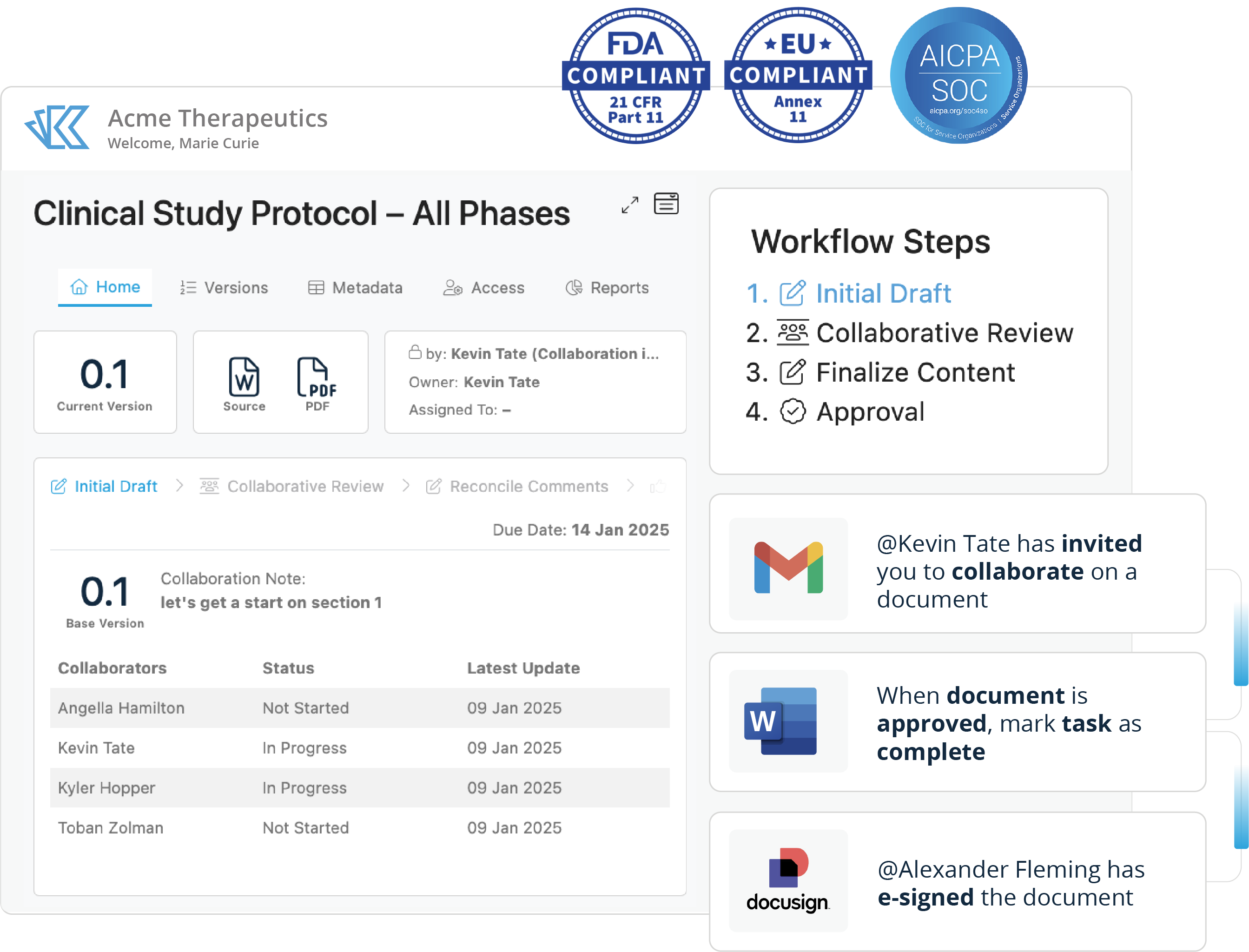
Kivo is a cloud-based, unified compliance platform for life sciences companies that includes RIM alongside Document Management (DMS), electronic Trial Master File (eTMF), and Quality Management (QMS) — all built on one shared, Part 11-compliant document core. Kivo's RIM module covers submission forecasting and resource planning, dossier management, submission document management and electronic submissions, product registration management, and health authority commitment and correspondence tracking — including an eCTD Viewer accepted for FDA, EMA, PMDA, Health Canada, Swissmedic, TGA, HSA, and MFDS submissions, linked live to the underlying DMS.
Kivo includes its own native, Part 11-compliant electronic signature with every subscription at no additional charge, and implementation follows a 5-step process — aligning to the EDM Reference Model, migrating documents and correspondence via secure FTP, loading validation evidence, a system walkthrough, and training — typically completed in weeks rather than months. More than 200 sponsor, consultant, and CRO teams currently run on Kivo, and Kivo holds a 4.9/5 rating on G2.
"Kivo is a 'right sized' tool that allows a life sciences company to establish and maintain compliance with regulated documentation practices without going overboard on complexity." — Ken V., CEO
Kivo's support comes from real people rather than bots or tiered queues. See our RIM solution page for full module details.
Frequently Asked Questions
What is regulatory information management (RIM)?
Regulatory information management (RIM) is the identification, collection, curation, and management of regulatory information for products across the life sciences value chain — spanning submission planning and tracking, health authority correspondence, product registrations, and electronic document management. RIM gives regulatory teams a single source of truth instead of scattered spreadsheets and email threads.
How does a RIM system support global submissions planning?
A RIM system supports global submissions planning by tracking country-specific requirements, correspondence, and commitment deadlines across every health authority a sponsor works with in one system — rather than reconciling spreadsheets, email threads, and regional trackers separately for each agency, which is where multi-region programs typically lose time and miss deadlines.
Which RIM system supports complex pharma lifecycle management?
A RIM system built for complex lifecycle management should support submission forecasting, product registration tracking, and health authority commitment management together, so registration status, upcoming renewals, and open correspondence stay visible across a growing product portfolio, rather than requiring a separate tracker per product or region.
When should a company start using a dedicated RIM system?
Most teams start evaluating a dedicated RIM system as they approach or enter clinical trials, once submission volume, health authority correspondence, and cross-functional coordination outgrow spreadsheets and shared drives — often triggered by a near-miss during an inspection or urgent submission.
References:
- Balasubramanian V., Mahoney-Jewels S., Brewer-Yizar V., et al., "Regulatory Information Management Whitepaper V2." DIA Regulatory Affairs Community Regulatory Information Management (RIM) Working Group. Jan 21, 2019.
- Gens S., et al., "2025 Operational Excellence and World Class RIM℠ Performance Edition." Gens & Associates, released April 2026. https://gens-associates.com/world-class-rim-research/.
- "Trends In FDA FY 2025 Warning Letters." Pharmaceutical Online, 2026 — FDA issued 303 warning letters to drug and biologics products in FY2025, a 59% increase from 190 in FY2024.
