

This guide provides a comprehensive look at the landscape of healthcare compliance services.
We will explore the core functions every organization must manage, the economics of different engagement models, and why the industry is shifting toward tech-enabled services to solve the perennial problem of sustainability.
Part I: The Seven Elements of an Effective Program
Regardless of whether you are a hospital administrator or a biotech CEO, the standard for what constitutes a "good" compliance program is largely defined by the Office of Inspector General (OIG) of the U.S. Department of Health and Human Services.
The OIG has outlined seven fundamental elements of an effective compliance program. When you hire a healthcare compliance service firm, you are typically hiring them to bolster one of these seven pillars where your internal team lacks bandwidth or expertise.
Understanding these elements is the first step in diagnosing your own needs.
1. Written Policies and Procedures
This is the foundation. You cannot comply with rules that aren’t written down. Service providers in this area help draft the Code of Conduct, Standard Operating Procedures (SOPs), and policies that govern daily operations.
-
The Service Need: Many organizations have policies that are outdated or cut-and-pasted from generic templates. Consultants are often brought in to "operationalize" these policies, rewriting them so they actually match the workflow of the staff.
2. Compliance Leadership and Oversight
The government expects a designated Chief Compliance Officer (CCO) and a Compliance Committee.
-
The Service Need: For smaller organizations, hiring a full-time, experienced CCO is cost-prohibitive. This has given rise to "Fractional CCO" services, where an external expert serves in this role on a retainer basis.
3. Training and Education
Having a policy is useless if no one reads it. Effective training is the primary defense against negligence.
-
The Service Need: Creating engaging, role-specific training modules. "General compliance" training is often ignored; service providers help tailor content (e.g., "Anti-Kickback training for Sales Reps" vs. "GCP training for Clinical Scientists").
4. Effective Lines of Communication
Employees must have a safe, anonymous way to report irregularities without fear of retaliation (whistleblower protections).
-
The Service Need: Third-party vendors often manage anonymous hotlines or web portals to intake complaints, ensuring independence and confidentiality.
5. Internal Monitoring and Auditing
You cannot wait for the government to find your mistakes. You must find them first.
-
The Service Need: This is the largest category of compliance services. It involves "mock audits", proactive stress tests of your billing, your clinical trials, or your manufacturing quality to identify gaps.
6. Enforcement of Standards
There must be consequences for non-compliance.
-
The Service Need: HR and legal consultants often assist in designing disciplinary matrices to ensure that penalties are applied consistently across the organization, regardless of an employee's seniority.
7. Prompt Response and Corrective Action
When a problem is found, it must be fixed.
-
The Service Need: "Remediation Services." If an audit finds a systemic error, teams of consultants are deployed to fix the historical data and redesign the process to prevent recurrence.
Part II: The Three Core Categories of Compliance Services
While the OIG provides the theoretical framework, the actual services offered in the market generally fall into three operational categories. Identifying which category applies to your business is critical to finding the right partner.
Category 1: Corporate, Ethics, & Commercial Compliance
This category focuses on the financial and ethical relationships between healthcare businesses and the medical community. The primary goal is to prevent fraud, bribery, and conflicts of interest.
Fair Market Value (FMV) Assessments
If a pharmaceutical company or hospital pays a physician to speak at a conference, consult on a board, or serve as a medical director, they must prove the payment is "Fair Market Value." If they pay too much, it looks like a bribe (kickback) to induce referrals.
- The Service: Specialized firms provide "FMV Opinions", data-backed reports certifying that a specific hourly rate is appropriate for a specific doctor's specialty and experience level.
Transparency Reporting (The Sunshine Act)
In the U.S. (and increasingly globally), companies must report value transfers to physicians and teaching hospitals. This data is made public.
- The Service: Managing the aggregation of thousands of expense reports, cross-referencing them with doctor NPI numbers, and submitting the "Open Payments" report to the CMS is a massive administrative burden often outsourced to managed service providers.
Anti-Kickback & Stark Law Consulting
These are complex statutes that govern referrals. A "Stark Law" violation can occur even if the mistake was unintentional.
- The Service: Legal and advisory reviews of physician contracts, joint ventures, and lease arrangements to ensure they fall within "Safe Harbors."
Category 2: Privacy, Security, & Data Compliance
In the digital age, patient data is currency. Protecting that data is a board-level imperative.
HIPAA & HITECH Compliance
The Health Insurance Portability and Accountability Act (HIPAA) sets the standard for protecting sensitive patient data.
- The Service: HIPAA Risk Assessments. Consultants physically and digitally inspect your facility. They check if computer screens are visible to the public, if passwords are shared, and if servers are encrypted.
Cybersecurity & Incident Response
Healthcare is the #1 target for ransomware attacks.
- The Service: Penetration testing (white-hat hacking) to find vulnerabilities, and "Incident Response Retainers", paying a firm to be on standby to rescue your data if a breach occurs.
GDPR (Global Data Privacy)
For companies operating in Europe, the General Data Protection Regulation (GDPR) imposes even stricter rules than HIPAA regarding the "Right to be Forgotten" and data sovereignty.
Category 3: Quality & Regulatory Services
For organizations that manufacture products (drugs, devices, diagnostics), compliance is not just about billing or privacy; it is about the physical integrity of the product. This is the world of the FDA, EMA, and ISO standards.
Quality Management Systems (QMS)
Every life sciences company must have a QMS, a system of procedures that ensures product consistency.
- The Service: "QMS Build & Implementation." Consultants design the quality manual and write the hundreds of SOPs required to operate (e.g., 21 CFR Part 820 for devices, Part 211 for pharma).
Validation Services (CSV/CSA)
The FDA requires that any software touching patient safety or product quality be "validated" to prove it works as intended.
- The Service: Computer System Validation (CSV). This is a technical service where engineers write and execute test scripts for your software (like an eTMF or ERP system) to document that it is compliant with 21 CFR Part 11 (Electronic Records).
Clinical Compliance (GCP)
Running clinical trials on humans requires strict adherence to Good Clinical Practice (GCP).
- The Service: Trial Master File (TMF) Auditing. The TMF is the story of your trial. Service providers audit these massive file repositories to ensure every document, from the ethical board approval to the nurse's CV, is present and correct.
Regulatory Strategy
Advisory services for interacting with agencies.\
- The Service: Preparing for FDA meetings (Pre-IND, Pre-NDA), drafting orphan drug applications, and conducting "Mock Inspections" to prepare staff for the scrutiny of a BIMO (Bioresearch Monitoring) inspection.
Part III: Hiring Expertise
Once you have identified the type of service you need, the next challenge is determining the model of engagement. The market has evolved beyond the traditional "hourly consultant" into more flexible structures.
1. The Project-Based Model
"The Fixer" You hire a firm to complete a specific, time-bound task with a clear deliverable.
-
Common Use Cases: Performing a mock audit, writing a specific set of policies, or validating a new software system.
-
The Economics: Fixed Fee or Time & Materials (capped).
-
Pros: Predictable budget. High level of expertise for a short burst.
-
Cons: Transactional. Once the project is done, the knowledge leaves with the consultant.
2. The Staff Augmentation Model
"The Contractor" You hire a firm to provide "bodies in seats." These are external contractors who function as temporary employees, embedding within your teams to handle overflow work.
-
Common Use Cases: Backfilling a maternity leave, handling a surge in workload before an FDA submission, or manually reviewing thousands of documents for a remediation project.
-
The Economics: Hourly Rate (usually a premium over full-time salary).
-
Pros: Flexibility. You can scale the team up or down instantly without HR hurdles.
-
Cons: Management overhead. Your internal managers must direct their daily work. If supervision is poor, efficiency drops.
3. The Managed Services Model
"The Outsourcer" You fully outsource a specific function to a third-party vendor who manages it on an ongoing basis.
-
Common Use Cases: Transparency (Open Payments) reporting, anonymous hotline management, or vendor qualification.
-
The Economics: Annual Subscription or Monthly Retainer.
-
Pros: "Set it and forget it." Reduces internal headcount and administrative burden.
-
Cons: Loss of control. It can create a "black box" where you don't know if the work is being done correctly until a problem arises.
4. The Fractional Leadership Model
"The Expert" For small to mid-sized organizations, hiring a full-time Chief Compliance Officer or VP of Quality is often too expensive ($200k-$300k+). "Fractional" services provide a senior executive for 5–10 hours a week.
-
Common Use Cases: Early-stage biotech startups, small healthcare tech firms.
-
The Economics: Monthly Retainer.
-
Pros: Access to C-suite strategy and "adult supervision" at a startup price point.
-
Cons: Bandwidth. A fractional leader cannot do the "grunt work." They set the strategy, but you need internal junior staff or systems to execute it.
Part IV: Evaluating Service Providers
The healthcare compliance services market is crowded. When vetting potential partners, use this framework to separate high-quality partners from generic firms.
1. Specialization vs. Generalization
Be wary of "Generalist" firms that claim to do everything.
-
The Test: If a firm’s website talks mostly about "Medical Coding" and "Billing," they are likely not the right partner for an FDA Regulatory Strategy project. If they talk about "GxP" and "Clinical Trials," they likely don't know how to handle hospital revenue cycles.
Choose a niche specialist over a massive generalist, unless you are a massive conglomerate that needs global scale.
2. The "Scare Tactic" Test
Some consultants sell by fear. They will terrify you with stories of million-dollar fines and prison sentences to pressure you into a contract.
-
The Test: Good compliance partners focus on Business Enablement, not just Risk Avoidance. They should say, "Here is how we help you scale safely," not "Here is why you are going to jail."
3. Independence
For auditing services, independence is non-negotiable.
-
The Test: You generally want to avoid using the same firm to design your compliance program and audit it. That is grading your own homework. Separation of duties ensures an unbiased assessment.
Part V: The Hidden Risk Of Outsourced Expertise
There is a fundamental flaw in how healthcare compliance services have historically been consumed. It is the problem of Sustainability.
You can hire the best service provider in the world. They can write perfect policies, clean up your files, and train your staff. On the day they leave, your compliance status is "Green."
But the moment they walk out the door, entropy sets in.
-
Employees revert to old habits (emailing sensitive documents instead of using the secure portal).
-
New regulations emerge, rendering the paper SOPs obsolete.
-
Files are saved in the wrong folders, ruining the audit trail.
-
Training deadlines are missed.
Six months later, the "pristine" environment you paid for is messy again. This leads to the "Cycle of Dependency." Organizations find themselves hiring consultants every 12–18 months to fix the same problems over and over again.
Why does this happen? It happens because organizations view compliance as a Personnel problem ("I need to hire an expert") rather than an Infrastructure problem ("I need a system to enforce the rules").
Part VI: Tech-Enabled Services
To break this cycle, the market is shifting. The most forward-thinking healthcare compliance firms are moving away from manual spreadsheets and "paper" deliverables. Instead, they are delivering their services via Compliance Platforms.
This is the concept of Tech-Enabled Services.
In this modern model, the consultant doesn't just write a policy; they configure a workflow.
-
The Old Way: A consultant writes a "Training SOP" and hands you a PDF. You are responsible for remembering to email it to new hires.
-
The New Way: A consultant configures a Learning Management System (LMS). When a new hire is added to HR, the system automatically assigns the training and blocks their access to data until they pass the quiz.
The "Service" is the strategy and setup; the "Technology" is the enforcer.
The Role of Platforms in Life Sciences
This shift is especially visible in the Life Sciences sector, where the regulations are incredibly strict.
Historically, companies had to buy separate software for every function: one for Quality, one for Regulatory, and one for Clinical trials. Consultants would charge hours to manually move data between them.
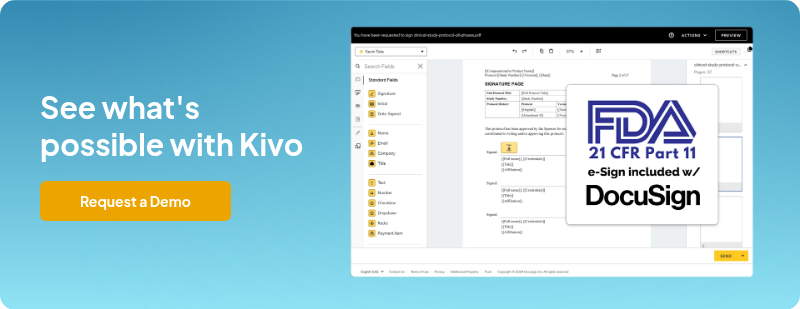
Today, Unified Platforms like Kivo are changing how services are delivered. Kivo acts as the "Operating System" for compliance services. It combines Document Management, Quality Systems (QMS), Regulatory Information (RIM), and Clinical Trial files (eTMF) into one workspace.
A prime example of this Service + Platform synergy comes from Kivo's partnership with SSI Strategy, a leading life sciences consultancy.
SSI's emerging biotech clients were often trapped between two bad options: expensive, clunky enterprise software or non-compliant DIY folders like SharePoint.
After taking note of Kivo's work with one of their clients, SSI partnered with Kivo to operationalize their expertise. By pre-configuring their proprietary Quality methodology directly into the Kivo platform, SSI created a turnkey Quality foundation for new and existing clients.
Now, instead of needing months of work (and billable hours) to build a configure quality programs and software from scratch for every new client, SSI can deploy a fully validated, compliant Quality Management System in less than 8 weeks. This illustrates the future of compliance services: the consultant delivers the strategy, and the platform delivers both the immediate infrastructure to execute it AND the hub for maintaining consistent implementation after the consulting experts leave.
Why Smart Service Providers Recommend Platforms like Kivo:
-
The "Leave-Behind" is an Asset: When a consultant builds your compliance program inside Kivo, they aren't leaving you with a static binder. They are leaving you with a living, breathing engine. The workflows they built continue to run. The audit trails continue to log. The system remains "Audit Ready" long after the consultant is off the payroll.
-
Cost Efficiency (Stopping the Grunt Work): A significant portion of traditional service fees is spent on low-value administration, formatting headers in Word docs, scanning wet-ink signatures, and manually updating tracker spreadsheets. Platforms like Kivo automate this. This means your service budget is spent on high-value strategy (e.g., "How do we answer this FDA question?") rather than administration.
-
Single Source of Truth: In the old world, the Regulatory Consultant and the Clinical Consultant worked in silos. Kivo forces them to work in the same environment. When the Clinical team updates a protocol, the Regulatory team sees it instantly. This eliminates version control errors, one of the most common reasons for regulatory delays.
Part VII: Healthcare Compliance Services Checklist
The era of viewing healthcare compliance as a "checkbox" exercise is over. The regulatory environment is too complex, and the data requirements are too high.
As an executive, your goal should not be to simply "outsource" compliance to a service provider. Your goal should be to internalize control while leveraging external expertise.
Your Checklist for success:
-
Diagnose the Pillar: Are you solving for Provider Ethics, Data Privacy, or Product Quality?
-
Select the Model: Do you need a "Fixer" (Project), a "Contractor" (Staff Aug), or an "Expert" (Fractional)?
-
Demand Infrastructure: Don't just buy hours; buy capabilities.
When you issue an RFP (Request for Proposal) for compliance services, ask the provider: "What technology do you use to ensure this work lasts?"
If their answer is "Excel and Sharepoint," you are buying a temporary fix. If their answer is "We implement a unified platform," you are building a permanent foundation.
For Life Sciences companies specifically, the combination of Expert Services + A Unified Platform (like Kivo) is the gold standard. It turns the regulatory burden into a strategic asset, ensuring that when the time comes to submit, partner, or sell, your organization is ready.
