

When the U.S. Food and Drug Administration approves a new drug, it feels like big national news.
There is a press release. News stories call it a breakthrough. Doctors start learning about a new treatment. Patients and families read about hope.
It seems instant. It seems like everyone now has access.
But approval and access are not the same thing.
The FDA’s decision applies across all 50 states on the same day. Real-world access takes more time. A doctor has to write a prescription. A pharmacy has to stock the drug. A claim has to be processed. For Medicaid patients, the first proof that a drug is being used shows up in claims data.
That does not always happen at the same time in every state.
Our analysis of Medicaid prescription data shows that new drugs usually reach patients within a few months of approval. But the timing varies by state. The difference is measured in months, not years. Even so, for someone waiting on treatment, a few months can matter.

What the Data Shows Nationwide
We looked at State Drug Utilization Data from the Centers for Medicare & Medicaid Services. This public dataset shows quarterly Medicaid prescriptions for each state.
We focused on new drugs approved in 2024 and 2025. For each drug, we found when it first appeared in Medicaid claims anywhere in the country. Then we measured how long it took for each state to record its first Medicaid prescription for that drug.
Because the data are reported every three months, we measured time in quarters and converted it into months.
We found that the average delay between the first national Medicaid prescription and the first prescription in a specific state ranged from about two months to about five months.
In many states, at least half of the new drugs appeared in the same quarter as their first national use. In other states, it took longer.
The key point is that rollout is not perfectly synchronized across the country.
States Where Drugs Reach Patients Fastest
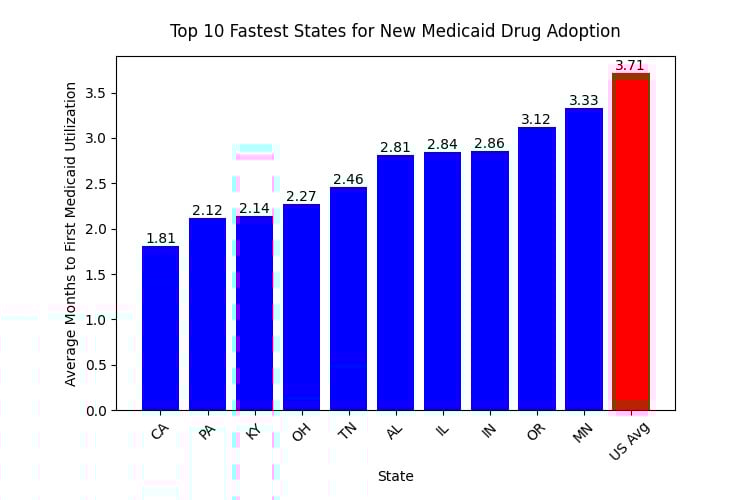
In the fastest states, new drugs appeared in Medicaid claims about two to two-and-a-half months after they first appeared anywhere in the country.
The 10 fastest states were:
- California
- Pennsylvania
- Kentucky
- Ohio
- Tennessee
- North Carolina
- Michigan
- Georgia
- Indiana
- New York
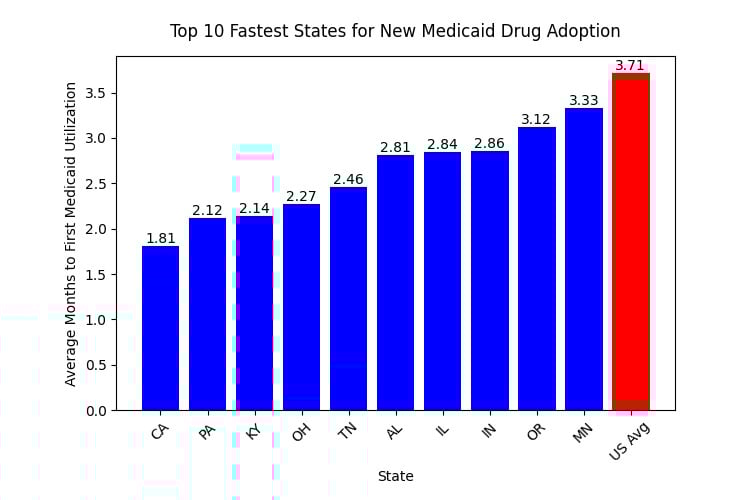
In several of these states, many drugs showed up in the same quarter as the national first prescription.
Larger states such as California and New York may move faster because they have more patients and more prescriptions overall. That increases the chances that the first eligible patient fills a prescription sooner.
However, size is not the only factor. Kentucky also ranked near the top.
What these states have in common is consistency. Many different drugs appeared relatively quickly, not just one or two.
States Where Drugs Take Longer to Appear
Some states showed longer delays before new drugs appeared in Medicaid claims.
The 10 slowest states were:
- Utah
- Iowa
- Kansas
- Nebraska
- Mississippi
- South Dakota
- North Dakota
- Wyoming
- Montana
- West Virginia
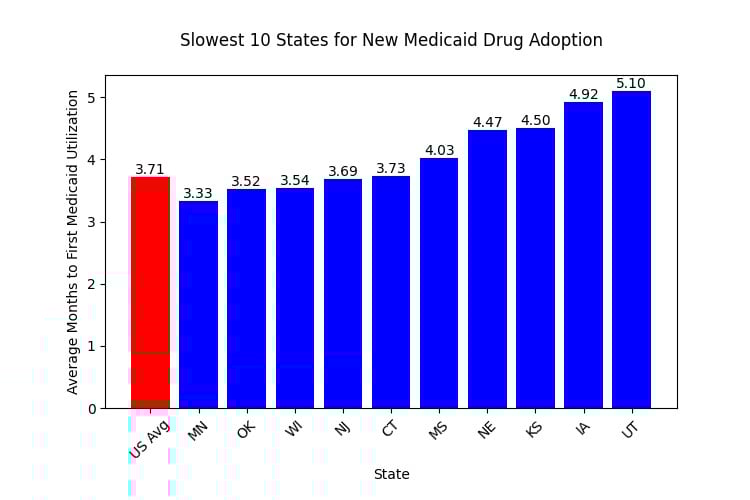
In these states, the average delay was closer to four to five months. In several cases, at least half of the drugs did not appear until the next quarter.
It is important not to jump to conclusions.
A longer delay in claims data does not automatically mean the state denied coverage. Smaller states often have fewer prescriptions overall. Some new drugs treat rare conditions. If only a small number of patients qualify, it may take longer for the first prescription to be filled.
Even so, the gap between the fastest and slowest states adds up to about three months. For patients closely following a new treatment, that difference can feel important.
Why the Differences Might Exist
Why is there such a wide gap between the fastest states and the slowest?
Several factors may affect timing:
-
Administrative processes: state Medicaid programs may review new drugs before adding them fully into their systems.
-
Managed care systems: many states use managed care organizations to run Medicaid. Each system may move at a different pace.
-
Prescribing patterns: if a drug treats a small group of patients, it may take longer for the first prescription to appear.
-
Provider awareness: doctors in some areas may adopt new treatments faster than others.
-
Reporting cycles: because the data are reported every three months, small timing differences can look larger in the data.
All of these factors together help explain why rollout is not identical in every state.
What This Means for Patients
For many people, a difference of one or two months may not change long-term outcomes.
But for some patients, timing matters.
Earlier access can mean earlier symptom relief. It can mean fewer side effects. It can improve quality of life.
At the same time, most states show new drug use within a few months of national rollout. The differences are measured in months, not years.
This analysis does not show widespread denial of access. It shows that when a national approval meets a state-run system, small timing differences naturally occur.
FDA approval is national. Medicaid is run by states. When those systems meet, rollout happens at slightly different speeds.
A National Decision, A Local Timeline
When a new drug is approved, the news feels immediate.
In reality, moving from approval to the first prescription involves doctors, patients, pharmacies, and state systems.
The differences we found are not dramatic. But they are real.
In some states, new drugs appear in Medicaid claims within weeks. In others, it takes a few months longer.
Where you live does not change the approval date. But it can shape how quickly a new treatment becomes part of everyday care.
And in health care, even a small difference in timing can matter.
