

There are more medical treatments available today than ever before, and yet each day, someone new is diagnosed with a condition for which effective treatments are not publicly available.
For folks in this position, there remains hope that a novel treatment exists within the thousands of clinical trials happening around the US. Clinical trials are the primary catalyst for medical progress. They are the conduit for turning ideas into treatments.
But whether or not a patient can get access to the right trial has a lot to do with their location.
Clinical trials are concentrated much more heavily in states that host the research hospitals, physician networks, and federal funding to support them. And that means that were you live dictates your access to care today, as well as how long it takes new treatments to reach you in the future.
This analysis looks at which states are running the most clinical trials, which are lagging, and what that geographic gap means for patients. This analysis was created by Kivo, a document, content, and process management platform designed for modern pharma teams.

What Clinical Trial Activity Actually Measures
Not all clinical trial volume is equal. A state can have thousands of registered trials without being a meaningful hub for patient enrollment. For this analysis, we focused on trials that are currently open and seeking participants, normalized per one million residents to allow fair comparison across states of very different sizes.
The data comes from ClinicalTrials.gov, the NIH's public registry of federally and privately supported clinical studies.
- Active trial counts were captured for all 50 states.
- Population figures were drawn from U.S. Census estimates via the FRED database.
The resulting access score reflects two things: active trial volume and trial density per capita. Together, they give a picture of where clinical trials are most accessible around the US.
States With The Best Access To Clinical Trials
The 10 states ranking highest in access to clinical trials include:
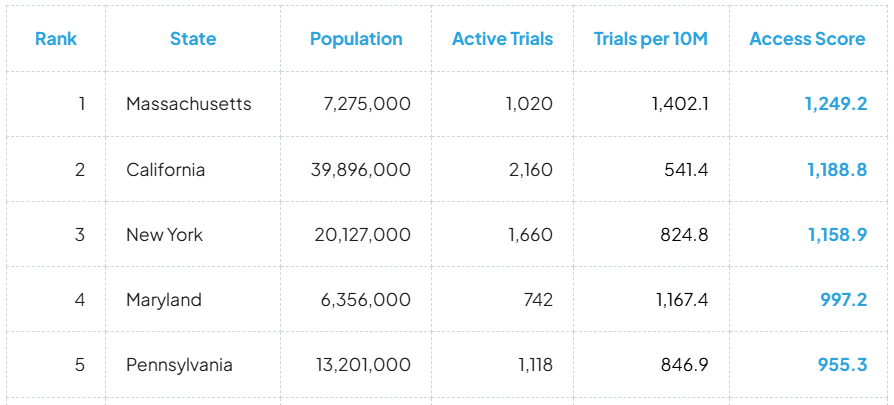
- Massachusetts — 1,249.2
- California — 1,188.8
- New York — 1,158.9
- Maryland — 997.2
- Pennsylvania — 955.3
- Texas — 813.3
- Illinois — 796.0
- Connecticut — 790.3
- Ohio — 748.7
- North Carolina — 727.1
Massachusetts wins the top access score by a fair margin. Not only does it rank first in active clinical trials per capita, it also ranks 5th in total active trials. The state's top-rated trial access is due in large part to it being home to some of the most important medical research institutions in the world, including Massachusetts General Hospital, Dana-Farber Cancer Institute, and the Brigham and Women's Hospital.
California, New York, and Texas place high in the rankings off the back of sheer volume. Despite one of the lowest trial rates per capita in the country, California's 2,160 active trials dwarf the competition. New York hosts the second most trials ( 1,660) while also boasting a high trial rate per capita. Texas shares California's bottom-tier rate per capita but comes in third for total trials, with 1390.
A patient in Los Angeles, San Francisco, or New York City will have access to a concentration of trials that few places in the world can match, and around half of Texas lives within a 1-hour drive of research hubs in Dallas/Ft. Worth, Austin, and San Antonio
Maryland, Pennsylvania, and Connecticut also showing up in the top 10 demonstrates the exceptional healthcare and medical research access within the Northeastern United States.
Finally, Ohio, Illinois, and North Carolina's presence prove that states don't need to boast massive population centers in order to build exceptional medical research infrastructure.
When More Trials Doesn't Mean Better Access
Raw trial count can be misleading. California ranks second overall with 2,160 active trials, but with nearly 40 million residents, it sits 47th in the country on a per-capita basis. Texas ranks sixth overall despite ranking 49th per capita. Florida runs 945 active trials and still finishes last in per-capita access.
One reason for this is that population growth in these states has consistently outpaced the expansion of research infrastructure. California has gained roughly 10 million residents since 2000. Texas has added more than 12 million. The medical research infrastructure in these states has been unable to keep pace, and in Texas' case, neither has broader healthcare infrastructure.
This can often create two vastly different experiences for residents in large states. A patient in or near a large urban area like Los Angeles, Houston, or Miami will have access to world-class research hospitals running hundreds of active studies.
Meanwhile, a patient three hours away in rural East Texas or the Florida Panhandle is working with an entirely different set of options. The statewide average fails to tell either story accurately, and that is one of the biggest limitations of ranking access by state.
Texas illustrates this tension better than anywhere else. Despite its low per-capita ranking, roughly half of the state's population lives within an hour's drive of major research hubs in Dallas/Fort Worth, Austin, or San Antonio. For those residents, access is genuinely strong. For the other half, spread across 254 counties in a state larger than any country in Western Europe... access feels closer to the states making up the bottom of our ranking.
The States Falling Behind
The 10 states with the lowest access scores are:
41. Arkansas — 457.1
42. Kansas — 445.9
43. Hawaii — 433.4
44. New Mexico — 431.1
45. Montana — 421.8
46. Oklahoma — 417.0
47. Alaska — 412.6
48. Idaho — 378.3
49. Wyoming — 360.5
50. Mississippi — 348.
With only 142 active trials, despite a population of nearly three million, Mississippi ranks in the bottom three in access per capita and gets the lowest access score on our list. As might be expected from a state that has consistently refused to invest in healthcare and medical research, Mississippi also ranks near the top of the list for cancer mortality and chronic disease burden.
Arkansas joins Mississippi in representing the worst trial access in the Southern United States for essentially the same reasons: a sizeable population with a very small number of active trials.
Wyoming and Alaska find their way to the bottom of the list in large part due to their tiny populations. With under a million residents, very little medical research infrastructure exists in these states, and as a result, they make up the bottom two spots in total active trials, with less than 50 in either state.
Oklahoma, Montana, New Mexico, and Kansas join Mississippi and Arkansas as states where long-term failure to invest in medical infrastructure has resulted in both low trial access and generally low healthcare scores across numerous studies.
And finally, Idaho and Hawaii demonstrate that healthcare infrastructure and medical research infrastructure are not always equivalent. These states boast top-20 scores for healthcare while still showing up in the bottom-10 for clinical trial access, likely due to their more remote locations relative to coastal research hubs.
What Conditions Are Being Studied?
Cancer research is the dominant focus among active clinical trials today, and that should come as no surprise, as cancer has been a one of the top two leading causes of death in the US for the last 75 years.
More than a third of all actively recruiting trials are focused on oncology, driven largely by NCI funding and the network of cancer centers that receive it. Most of the states with top access scores, like Massachusetts, Maryland, and New York, are home to multiple NCI-designated centers.
Heart disease, neurological conditions, and rare diseases make up a significant share of the remaining studies. Rare disease trials in particular tend to stay close to large academic medical centers, since the patient populations are small and the diagnostic work requires specialized equipment and expertise.
The hardest cases are the states with both serious disease burdens and limited trial access. Mississippi, Oklahoma, and Arkansas have some of the highest cancer mortality and chronic illness rates in the country, which means patients in those states are dealing with some of the most pressing health needs while having below-average access to healthcare and the clinical studies that might offer them help.
Clinical Trial Access by State
The table below shows active recruiting trial counts, population size, per-capita density, and trial access scores for all 50 states.
| Rank | State | Population | Active Trials | Trials per 10M | Access Score |
| 1 | Massachusetts | 7,275,000 | 1,020 | 1,402.1 | 1,249.2 |
| 2 | California | 39,896,000 | 2,160 | 541.4 | 1,188.8 |
| 3 | New York | 20,127,000 | 1,660 | 824.8 | 1,158.9 |
| 4 | Maryland | 6,356,000 | 742 | 1,167.4 | 997.2 |
| 5 | Pennsylvania | 13,201,000 | 1,118 | 846.9 | 955.3 |
| 6 | Texas | 32,417,000 | 1,390 | 428.8 | 813.3 |
| 7 | Illinois | 12,846,000 | 918 | 714.6 | 796.0 |
| 8 | Connecticut | 3,642,000 | 386 | 1,059.9 | 790.3 |
| 9 | Ohio | 12,002,000 | 832 | 693.2 | 748.7 |
| 10 | North Carolina | 11,376,000 | 784 | 689.2 | 727.1 |
| 11 | New Jersey | 9,743,000 | 712 | 730.8 | 723.3 |
| 12 | Arizona | 7,801,000 | 614 | 787.1 | 717.8 |
| 13 | Minnesota | 5,820,000 | 486 | 835.1 | 695.4 |
| 14 | Colorado | 6,070,000 | 498 | 820.4 | 691.5 |
| 15 | Rhode Island | 1,105,000 | 118 | 1,067.9 | 687.9 |
| 16 | Washington | 8,160,000 | 604 | 740.2 | 685.7 |
| 17 | Vermont | 646,000 | 68 | 1,052.6 | 658.8 |
| 18 | Tennessee | 7,387,000 | 506 | 685.0 | 613.4 |
| 19 | Florida | 24,307,000 | 945 | 388.8 | 611.3 |
| 20 | Missouri | 6,320,000 | 448 | 708.9 | 604.5 |
| 21 | Michigan | 10,255,000 | 612 | 596.8 | 602.9 |
| 22 | Alabama | 5,145,000 | 382 | 742.5 | 598.3 |
| 23 | Georgia | 11,414,000 | 642 | 562.5 | 594.3 |
| 24 | Oregon | 4,285,000 | 328 | 765.5 | 590.5 |
| 25 | Iowa | 3,230,000 | 258 | 798.8 | 582.5 |
| 26 | Nebraska | 2,005,000 | 168 | 837.9 | 569.9 |
| 27 | Wisconsin | 5,985,000 | 402 | 671.7 | 563.8 |
| 28 | South Dakota | 935,000 | 82 | 877.0 | 559.0 |
| 29 | Virginia | 8,964,000 | 512 | 571.2 | 547.5 |
| 30 | Delaware | 1,052,000 | 88 | 836.5 | 537.1 |
| 31 | Kentucky | 4,545,000 | 312 | 686.5 | 536.7 |
| 32 | Indiana | 7,013,000 | 422 | 601.7 | 529.8 |
| 33 | New Hampshire | 1,420,000 | 114 | 802.8 | 527.3 |
| 34 | Utah | 3,505,000 | 246 | 701.9 | 519.5 |
| 35 | North Dakota | 795,000 | 64 | 805.0 | 508.6 |
| 36 | Louisiana | 4,550,000 | 294 | 646.2 | 505.3 |
| 37 | Maine | 1,415,000 | 108 | 763.3 | 501.2 |
| 38 | West Virginia | 1,755,000 | 128 | 729.3 | 488.8 |
| 39 | Nevada | 3,280,000 | 214 | 652.4 | 477.1 |
| 40 | South Carolina | 5,520,000 | 314 | 568.8 | 466.9 |
| 41 | Arkansas | 3,105,000 | 196 | 631.2 | 457.1 |
| 42 | Kansas | 2,965,000 | 184 | 620.6 | 445.9 |
| 43 | Hawaii | 1,425,000 | 94 | 659.6 | 433.4 |
| 44 | New Mexico | 2,130,000 | 134 | 629.1 | 431.1 |
| 45 | Montana | 1,165,000 | 76 | 652.4 | 421.8 |
| 46 | Oklahoma | 4,105,000 | 224 | 545.7 | 417.0 |
| 47 | Alaska | 732,000 | 48 | 655.7 | 412.6 |
| 48 | Idaho | 2,015,000 | 112 | 555.8 | 378.3 |
| 49 | Wyoming | 588,000 | 34 | 578.2 | 360.5 |
| 50 | Mississippi | 2,925,000 | 142 | 485.5 | 348.1 |
Sources:
What This Means for Patients and Policymakers
For patients, it’s important to understand that where you live affects your chances of joining a trial. Once you know that, you can start looking for options beyond your local area.
Some programs now let patients take part in trials remotely, using telehealth visits instead of driving to a research hospital. These options are growing, but they haven't reached everyone yet.
For lawmakers and healthcare leaders, the message is clear. States that train more doctors, support major research hospitals, and build stronger health systems are both helping patients today and ensuring residents have timely access to the next generation of treatments.
