

.png)
Last Updated: October 2026
What features should a biotech QMS include?
At a minimum, a life sciences QMS should include controlled document management, Part 11-compliant electronic signatures, quality event management, audit and inspection readiness, training management, vendor qualification, automated workflows, reporting and alerts, validation and data integrity controls, and role-based access control.
A biotech quality management system (QMS) gives life sciences teams the controls they need to stay audit-ready and compliant with GxP, 21 CFR Part 11, and EU Annex 11.
The features below make up the core checklist most growing biotech and life sciences teams use when evaluating a QMS.
The 10 features every life sciences QMS should have:
- Controlled document management with version control
- Part 11-compliant electronic signatures
- Quality event management
- Audit and inspection readiness
- Training management
- Vendor and supplier qualification
- Automated workflows and approval routing
- Reporting, dashboards, and automated alerts
- Validation and data integrity controls
- Role-based access control and security
The rest of this guide explains what each feature does, why it matters in a regulated environment, and what to look for when you evaluate a system for your stage.
In this guide:
- 1. Controlled document management
- 2. Part 11-compliant electronic signatures
- 3. Quality event management
- 4. Audit and inspection readiness
- 5. Training management
- 6. Vendor and supplier qualification
- 7. Automated workflows and approval routing
- 8. Reporting, dashboards, and automated alerts
- 9. Validation and data integrity controls
- 10. Role-based access control and security
- Two features that matter most for growing teams
- How to evaluate QMS features for your stage
- QMS options teams commonly evaluate
- How Kivo QMS maps to these features
- Frequently asked questions
1. Controlled document management with version control
A life sciences QMS should be built on controlled document management, because nearly every quality process eventually points back to a document. SOPs, work instructions, policies, and records all need a single source of truth with enforced version control, so that the current effective version is always clear and superseded versions are retained for the record.
Look for a complete audit trail on every document action, including who created, edited, reviewed, and approved each version and when. This is the foundation auditors and inspectors expect, and it is what allows a CAPA or deviation to reference the exact controlled document that applies. For a deeper look at SOP control, see our guide to SOP management for pharma.
2. Part 11-compliant electronic signatures
Electronic signatures are a baseline requirement for any QMS operating under 21 CFR Part 11. Approvals on SOPs, quality events, and controlled documents need to be captured with compliant signatures that bind the signer, the meaning of the signature, and the timestamp to the record.
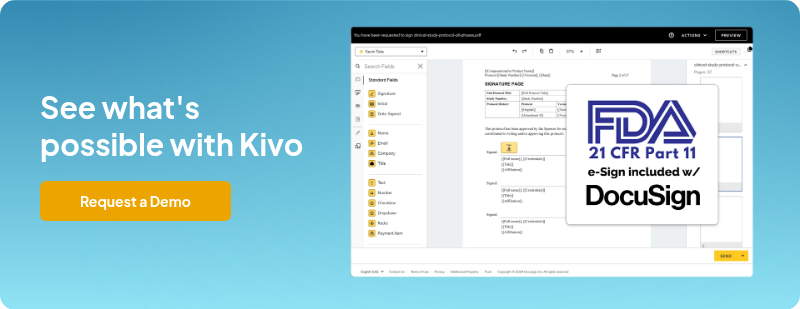
The cleanest setups offer this natively rather than relying on a separate signing tool added on top. Kivo, for example, includes Kivo Sign, a native Part 11-compliant e-signature capability, at no additional cost. A native signature flow keeps approvals inside the same system where the documents and quality records already live, which reduces handoffs and keeps the audit trail intact.
3. Quality event management
Quality event management is where a QMS earns its keep day to day. A strong system handles deviations, CAPAs, change control, and complaints in one place, with structured workflows that move each event from initiation through investigation, action, and closure.
Each quality event should link directly to the related documents, tasks, and owners, so the full history is connected rather than scattered across email and spreadsheets. That connection is what gives quality leaders a defensible record when an inspector asks how a specific issue was identified, investigated, and resolved. Our explainers on quality events in life sciences and CAPA quality management cover the workflows in more detail.
4. Audit and inspection readiness
A QMS should make audits and inspections something you are always prepared for rather than something you scramble to assemble. That means internal audits, external audits, and vendor audits are all managed inside the system, with findings, responses, and corrective actions tracked to completion.
Inspection readiness comes from having documents, training records, quality events, and audit history connected and retrievable on demand. When everything traces back through a single audit trail, producing evidence during an FDA or notified body inspection becomes a matter of retrieval rather than reconstruction. See the QMS capabilities FDA inspectors actually check for what to expect.
5. Training management
Training management ties your people to your procedures. A capable QMS lets you assign training based on role, link each training requirement directly to the relevant SOP or controlled document, and track completion across the team.
The most useful systems connect training to the document control system, so that when a procedure is revised, the people who need to be retrained are identified automatically. This closes a common compliance gap where staff continue working from an outdated version of a procedure.
6. Vendor and supplier qualification
Biotech teams rely heavily on vendors, CROs, and CDMOs, which makes supplier oversight a core QMS function. The system should support vendor qualification, ongoing vendor audits, and a maintained record of approved suppliers and their status.
Keeping vendor records inside the QMS, alongside the audits and quality events that involve them, gives you a complete picture of supplier performance and a ready answer when an inspector asks how you qualify and monitor the partners who touch your product. Our guide to building a vendor management audit program walks through the process.
7. Automated workflows and approval routing
Manual routing of reviews and approvals slows quality teams down and introduces room for error. A QMS should automate workflows so that documents and quality events move to the right reviewers and approvers in the right order, with status visible at every step.
Pre-structured and customizable templates help here, letting you standardize how common processes run while still adapting them to your organization. Automated routing also reduces the number of clicks and reminders required to keep work moving, which matters most for lean teams.
8. Reporting, dashboards, and automated alerts
Quality leaders need visibility into what is open, what is overdue, and what is trending. A QMS should provide reporting and dashboards that surface open quality events, upcoming training, pending approvals, and aging items at a glance.
Automated alerts and notifications keep work from stalling by prompting owners before deadlines pass. Intelligent reporting also supports management review and helps you spot recurring issues early, before they become inspection findings.
9. Validation and data integrity controls
In a regulated environment, the QMS itself has to be trustworthy. Under 21 CFR 11.10(a), systems that create electronic records must include "validation of systems to ensure accuracy, reliability, consistent intended performance, and the ability to discern invalid or altered records." The burden of validating a system can be significant for a small team. Look for software that is pre-validated and delivered with complete documentation, which reduces the validation work your organization has to take on for the platform itself. Keep in mind that customers retain validation responsibility for their own configured use, so the right question is how much of the lift the vendor removes.
Data integrity controls round this out. Strong audit trails, controlled access, and regular data integrity checks support the ALCOA principles that underpin GxP, 21 CFR Part 11, and EU Annex 11. For how small teams approach this, read how to manage Part 11 compliance with no IT team.
10. Role-based access control and security
A QMS holds sensitive, regulated content, so security and access control are non-negotiable. Role-based access control (RBAC) lets you define exactly who can view, edit, and approve content, with granular permissions that match your organization.
Supporting security features should include encryption of data in transit and at rest, detailed user permissions, and complete audit logging of system activity. Together these protect your records and demonstrate the control that auditors, inspectors, and future investors expect to see.
Two features that matter most for growing teams
The ten features above are the core. Two additional considerations tend to separate the systems that work for clinical-stage biotech and growing life sciences teams from the ones that do not.
Built for lean teams without a dedicated IT function
Many emerging biotech companies run quality without a large IT department, so usability and a manageable rollout carry real weight. Modern, purpose-built systems can often be implemented in weeks rather than the many months legacy platforms require, though actual timelines vary by company size and the scope of your configuration and migration. An interface that feels familiar shortens the path to adoption and reduces the training burden on a small team. See what QMS you can implement without a dedicated IT team and how long a life sciences QMS implementation takes.
A unified platform for all RegOps needs
Quality does not happen in isolation from documents, regulatory information, and clinical content. A unified platform keeps QMS connected to your DMS, RIM, and eTMF on a single system, so records, approvals, and audit trails flow across functions.
This is worth scrutinizing during evaluation. Some enterprise quality suites grew through acquisition, which can leave teams operating modules that were connected after the fact rather than designed together. Asking how the modules actually share data, and whether they live on one platform, helps you avoid that pattern.
How to evaluate QMS features for your stage
The right feature set depends on where your company is. A clinical-stage biotech with a small quality team should weight usability, fast implementation, and a system that delivers compliance out of the box. A mid-size organization managing more vendors, more products, and more concurrent activities will lean harder on quality event volume, reporting depth, and the connection between QMS, DMS, RIM, and eTMF.
In both cases, the goal is the same: choose a system whose features keep you audit-ready, reduce manual effort, and scale with you rather than forcing a painful migration later. For a side-by-side view of how teams choose, see our biotech QMS buyer's guide.
QMS Options Teams Commonly Evaluate Against These Features
These are QMS platforms life sciences teams commonly shortlist when working through the ten features above. Each is summarized on the same four points so you can compare like for like.
| Option | Category | Primary focus | Deployment | Validation and setup approach |
|---|---|---|---|---|
| Kivo | Purpose-built cloud eQMS | Clinical-stage biotech sponsors and the CROs and consultancies supporting them; QMS alongside RIM, eTMF, and DMS on one platform | Cloud SaaS | Vendor-delivered, CSA-aligned validation package with every release; native Part 11 e-signature included |
| Dot Compliance | Purpose-built cloud eQMS | Pharma, biotech, medical device, and cosmetics quality teams | Cloud, Salesforce-native | Described by the vendor as pre-validated, meeting 21 CFR Part 11 and EU Annex 11 |
| SimplerQMS | Purpose-built cloud eQMS | Small to mid-sized life sciences companies needing rapid deployment | Cloud SaaS (AWS) | Delivered validated according to GAMP 5, with pre-configured life sciences workflows |
| Greenlight Guru | Purpose-built cloud QMS | Medical device companies, with an emphasis on design controls and risk traceability | Cloud SaaS | Validated out of the box; aligned to ISO 13485 and FDA's QMSR |
| MasterControl Quality Excellence | Enterprise-scale QMS | Life sciences manufacturers, including complex and multi-site operations | Cloud | Structured six-phase implementation (plan, discover, configure, validate, deploy, onboard) led by its implementation team |
| Veeva Vault QMS | Enterprise-scale QMS | Pharma and biotech quality teams, contract manufacturers, and suppliers, as part of the Vault Quality Suite | Cloud | Delivered lifecycles, workflows, and data model for deviations, audits, complaints, change control, and CAPA |
This table is not an independent ranking and does not assess implementation quality, market share, or fitness for any particular organization. Details are summarized from each vendor's public materials as of October 2026; validate every option against your own requirements. For longer profiles, see our roundup of the best QMS platforms for life sciences and our guide to MasterControl alternatives.
How Kivo QMS Maps to These Features
Kivo QMS is built on the same Part 11-compliant document core as Kivo's DMS, RIM, and eTMF, so quality records, controlled documents, and training share one audit trail rather than being integrated after the fact.
Against the ten features above, Kivo QMS provides controlled SOP authoring and approval with enforced naming and templates; configurable quality events covering incidents and complaints, deviations and non-conformances, risk evaluations, change control, and CAPA; internal, vendor, and partner audits, including an Inspector role for remote audits; vendor and supplier management with approval status, renewal dates, and certification-expiry reporting; training built from content already in Kivo, with quizzes and native e-signature acknowledgments; configurable workflows and dashboards; and role-based access with an uneditable audit trail. Every release ships with a CSA-aligned validation package that customers review and approve rather than perform themselves, and Kivo is SOC 2 Type 2 and ISO 9001 certified.
Kivo is built for clinical-stage biotech teams and the partners who support them, from pre-IND through approval. Organizations that need deep, highly specialized enterprise-manufacturing modules may find dedicated enterprise platforms more granular. To see how the QMS module works with your own SOPs, explore Kivo QMS.
Frequently asked questions
What is a QMS in biotech?
A QMS in biotech is a system that manages the documents, processes, and records a life sciences company uses to maintain quality and stay compliant with regulations such as GxP, 21 CFR Part 11, and EU Annex 11. It typically covers controlled documents, quality events, audits, training, and vendor oversight in one place. For a deeper definition, see our guide on what a QMS is in life sciences.
What is the difference between a QMS and a DMS?
A DMS (document management system) controls documents, versions, and approvals. A QMS includes document control and adds the quality processes built on top of it, such as deviations, CAPAs, change control, audits, training, and vendor management. In practice, a life sciences QMS is usually built on a compliant document management foundation.
Is a cloud-based QMS compliant with 21 CFR Part 11?
Yes, a cloud-based QMS can be fully compliant with 21 CFR Part 11 when it provides compliant electronic signatures, complete audit trails, controlled access, and validation. Cloud systems purpose-built for regulated life sciences environments are designed to meet Part 11 and EU Annex 11 requirements while removing the need to manage IT infrastructure.
Do small biotech companies need a full QMS?
Small biotech companies benefit from a QMS as soon as they need to demonstrate control over quality processes, which often comes well before commercialization. A right-sized, easy-to-implement system lets a small team stay audit-ready and prepared for partner and investor due diligence without the overhead of an enterprise deployment.
What QMS features are required for an FDA inspection?
For an FDA inspection, the features that matter most are controlled document management with audit trails, Part 11-compliant electronic signatures, quality event management for deviations and CAPAs, training records tied to procedures, and audit and inspection history. The common thread is traceability: being able to retrieve connected, time-stamped records that show how quality was maintained.
