

Last Updated: September 2026
How should sponsors handle an end of study TMF transfer? Plan the transfer before the study ends. Agree scope and timeline with the CRO, confirm that the audit trail travels with the documents, receive files in a validated system through a secure channel such as SFTP, QC everything before you sign off on delivery, and never accept encrypted files without the key.
The sections below cover what to plan, what to check, what regulators expect, and how the main eTMF options handle transfer and long-term archiving.
In this article
- Why plan the transfer early
- A scenario: what a poorly managed transfer looks like
- Best practices for an end of study TMF transfer
- What regulators expect
- How the main eTMF options handle transfer and archiving
- How Kivo handles end of study TMF transfer
- Frequently asked questions
Why plan the transfer early
The end of study transfer moves study-related documents, data, and materials from the sponsor or contract research organization (CRO) to a repository for long-term storage and archiving, and it is the point where audit trails most often break. In the context of clinical trials, the end of study transfer is a crucial process that involves the transfer of various study-related documents, data, and materials from the sponsor or CRO to an appropriate entity or repository for long-term storage and archiving.
Clinical trials generate a significant amount of data, including patient data, study protocols, case report forms, and other documents that are critical for the integrity, transparency, and reproducibility of the study results. Proper long-term storage of these data ensures that they are securely preserved and can be accessed for future reference or regulatory purposes. For example, the International Council for Harmonisation of Technical Requirements for Pharmaceuticals for Human Use (ICH) provides guidelines on the retention of essential documents, including long-term data storage, in its Guideline for Good Clinical Practice (GCP). ICH has since finalized E6(R3), so confirm requirements against the current version rather than the older E6(R2) Addendum. Regulatory authorities such as the FDA also have specific regulations on the retention and archiving of clinical trial data, including requirements for electronic records and signatures.
Yet despite its importance, very few emerging life sciences organizations plan ahead for the end of study transfer of the electronic trial master file (eTMF), often breaking the audit trail and putting them out of compliance.
A scenario: what a poorly managed transfer looks like
A transfer that looks finished on paper can still leave a sponsor unable to open its own TMF during an inspection. Here is a scenario a Kivo customer navigated recently:
Brian, the Director of Regulatory Affairs at a small biotech company, was notified by the regulatory inspection agency that the company’s investigational therapy had been selected for approval contingent on a review of their Phase IIb trial. The agency informed Brian that they would be scheduling an on-site visit to carry out the inspection in the coming weeks.
Immediately after receiving the notification, Brian notified his colleagues, Lisa, the Clinical Project Manager, and Nicole, the Document Management Specialist. Although the Phase IIb trial was outsourced to a CRO, their company had acquired the Trial Master File (TMF) back from their CRO at the end of the study years ago. The team developed a plan of action and began preparing for the upcoming inspection.
Nicole informed Lisa that the trial documentation was stored on a thumb drive at Iron Mountain, so she placed a request for it to be retrieved from storage. The next day, the thumb drive arrived at the office. At that point, Nicole realized that her new computer did not allow her to use the USB port and she needed to contact IT for support. Once IT enabled her USB port, no one was able to find the e-mail containing the encryption key since the TMF transfer from the CRO was handled by an employee who had since left the company.
Brian and the team realized they were now at the mercy of reaching out to the CRO, hoping they can help. They worried about the possibility that the CRO might no longer have the encryption key or might have no record of the TMF.
As you can see, a poorly managed end of study transfer can jeopardize the many years and thousands of hours of work that go into a clinical trial. It is important for sponsors, CROs, and other stakeholders involved in clinical trials to be aware of all relevant regulations and guidelines and ensure that proper procedures are in place for the end of study transfer and long-term data storage.
Best practices for an end of study TMF transfer
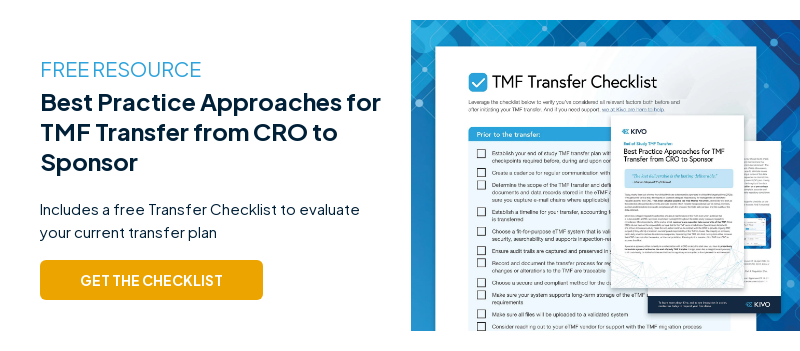
Good transfers share three traits: an early plan, documented quality checks, and an audit trail that arrives intact. Below is a list of best practices to follow when managing an end of study TMF transfer, grouped by when they apply.
Before the transfer
- Establish your end of study TMF transfer plan early with your CRO, and create a cadence for regular communication
- Include in your plan all the quality checkpoints required before, during and upon completion of the TMF transfer
- Determine the scope of the TMF transfer and define what needs to be transferred (all essential documents and data records stored in the eTMF as well as content from ancillary systems, make sure you capture e-mail chains where applicable)
- Establish a timeline for your transfer and account for time needed to check the contents of what is transferred
- Assess the quality of your TMF prior to the transfer and check for completeness and correctness of data and associated metadata
During the transfer
- Ensure audit trails are captured and preserved in your eTMF of record
- Record and document the transfer process for regulatory compliance and ensure that all changes or alterations to the TMF are traceable
- Chose a secure and compliant method for the data transfer i.e. SFTP
- Perform thorough QC on the transferred data
- Don’t accept files that are encrypted – unless you have the key and can secure it for later access
- Make sure all files are uploaded to a validated system
After the transfer
- Choose a fit-for-purpose eTMF system that is validated and streamlines workflow with built-in security, searchability and supports inspection-readiness
- Make sure your system supports long-term storage of the eTMF according to regulatory requirements
- Consider reaching out to your eTMF vendor for support with the TMF migration process
- Don’t sign off on finalization of delivery until you have completed a thorough quality check (QC)
Most importantly, don’t wait till the end of the study to plan for the TMF transfer.
What regulators expect
Regulators expect the sponsor to keep complete, retrievable essential records for the full retention period, wherever those records physically sit. ICH adopted the E6(R3) principles and Annex 1 in January 2025, and the guideline took effect in the EU on July 23, 2025. Its FDA effective date had not been determined at the time of writing, so check FDA's current status before relying on a date.
E6(R3) takes a risk-proportionate approach to essential records and calls for version control. It no longer sets a single fixed retention period; instead, retention follows applicable regional requirements, and the EU requires 25 years for clinical trial records. The investigator has overall responsibility for essential records, and the sponsor may support records management through technical solutions. In practice that means a sponsor should know where every record lives, be able to retrieve it quickly, and be able to show who changed what and when. See WCG Clinical's summary, ICH E6 (R3) is Here – What You Need to Know, for the changes in detail.
How the main eTMF options handle transfer and archiving
Every eTMF platform can hold a completed TMF, but they differ in how they receive a transfer and how they support long-term archiving, so compare them on those two points. This is a neutral overview, not a ranking, and it does not assess implementation quality, market share, or fit for any particular organization. Capabilities change, so confirm details with each vendor before you decide. Kivo is our product, so read this section with that in mind.
| Option | What it is | End of study transfer support | Long-term archiving |
|---|---|---|---|
| Kivo eTMF | Cloud eTMF built on the TMF Reference Model, part of one platform with document management, RIM and QMS | Validated migration ingests documents, metadata and audit trails from most TMF platforms and CROs by secure FTP, and recompiles a single unified audit trail | Designed for 25+ year retention, with read-only document states, a maintained audit trail and quarterly checksum integrity checks; no per-GB or per-study storage charges |
| Veeva Vault eTMF | Cloud eTMF from Veeva | Includes a TMF Transfer capability for exchanging completed TMFs between sponsors and CROs at study closure, per Veeva's product page | Confirm archiving terms and cost with Veeva |
| Montrium eTMF Connect | Cloud-based eTMF from Montrium | Confirm transfer and migration services with Montrium | Confirm archiving terms with Montrium |
| Ennov eTMF | eTMF from Ennov, available cloud or on-premises | Confirm transfer and migration services with Ennov | Includes an eTMF Archive component, per Ennov's site; confirm retention terms |
Whichever option you choose, ask five questions. Does the audit trail survive the transfer intact? Can you receive and QC files before sign-off? Is the system validated? What will long-term storage cost over 25 years? Can inspectors get read-only access quickly?
How Kivo handles end of study TMF transfer
Kivo brings a transferred TMF into a validated system with its audit trail intact, then keeps it inspection-ready for the long term. Migration runs through secure FTP, ingests documents, metadata and audit trails from virtually any TMF platform or CRO, and recompiles one unified audit trail even for documents that passed through several systems. Elevar Therapeutics used it to migrate 19 TMF studies, 73,794 documents, in 72 days.
For long-term storage, Kivo doesn't charge per GB or per study, which is one reason many sponsors bring the TMF in-house rather than leave it with the CRO. Kivo is SOC 2 Type 2 and ISO 9001 certified, is rated 4.9/5 on G2, and is used by 200+ sponsor, consultant and CRO teams. Learn more about Kivo eTMF, or talk to the team about planning your transfer.
Frequently asked questions
What is an end of study TMF transfer?
It is the handover of the trial master file, including documents, metadata and audit trails, from a CRO or other holder to the sponsor's own system of record when a study closes. A complete transfer lets the sponsor find any document, prove who changed it, and answer inspector questions without going back to the CRO.
When should you plan an end of study TMF transfer?
Plan it at study start, not study end. Put the scope, timeline, quality checkpoints and file format in the CRO contract and project plan, and review progress on a regular cadence. Early planning is what prevents lost encryption keys, missing metadata and broken audit trails once the CRO team has moved on to other work.
How long must a TMF be kept?
Retention follows applicable regional requirements rather than one fixed ICH figure. The EU requires 25 years for clinical trial records, and other regions and contracts may differ. Confirm the required period with your regulatory team, then choose a storage approach that keeps records readable, searchable and auditable for that entire time.
Why should you not accept an encrypted drive without the key?
Without the key, the files cannot be opened, so the TMF is effectively lost even though it physically exists. Either require an unencrypted transfer into a validated system, or store the key in a documented, access-controlled place that will outlast any single employee or vendor relationship.
Related reading
- TMF Archiving After Study Closeout
- Why Sponsors Shouldn't Leave The TMF with Their CRO
- How to Select an eTMF System
- The True Cost of Building and Maintaining an In-House eTMF

